Basionym: Echinocactus hastifer Werdemann & Boedeker, Notizbl. Bot. Gart. Mus. Berlin-Dahlem 11: 274 (1931).
Holotype: ex cult. Bot. G. Berlin, Mexico?, June 1930, Anonymus s.n. (B 81 0006882).
Synonyms: Ferocactus hastifer N.P. Taylor, Cact. Succ. J. Gr. Brit. 41: 90 (1979).
Description
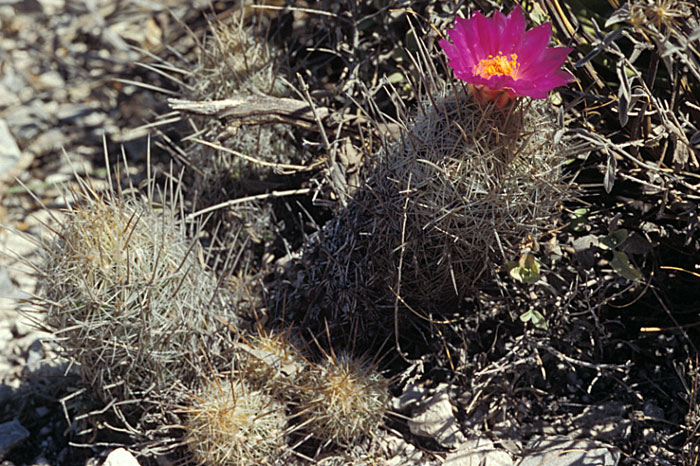
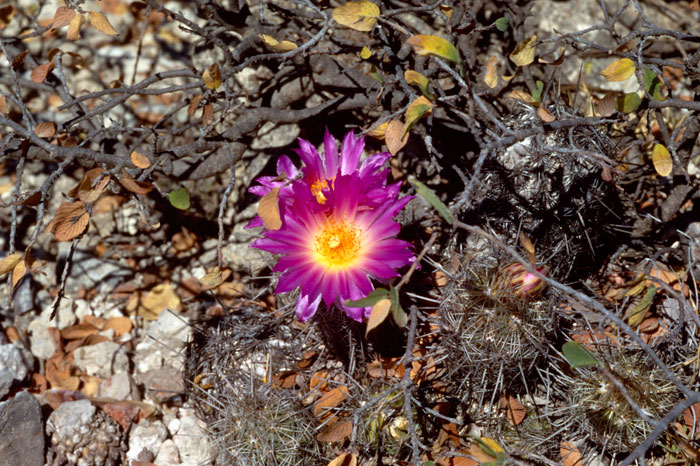
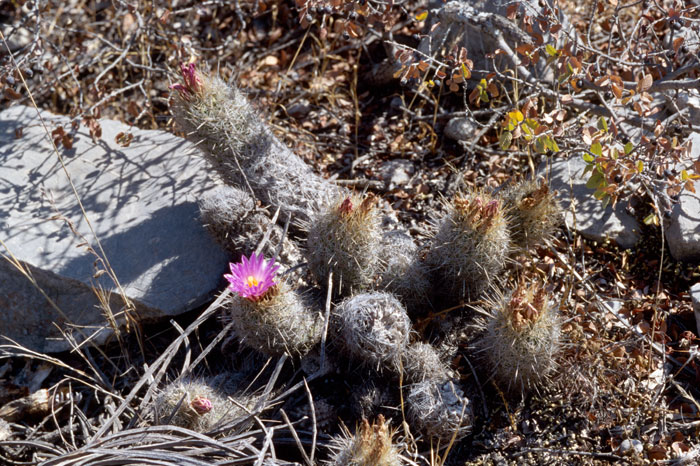
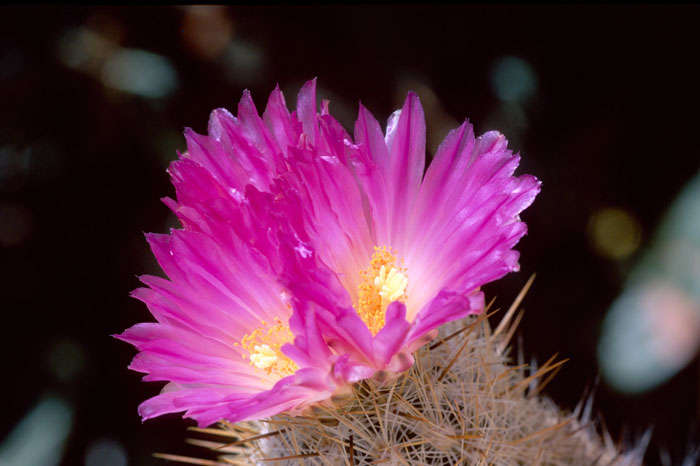
Stem clustering, cylindrical, 10-40 cm tall, 2.5-5.5 cm wide. Ribs 18, distinct. Tubercles rounded. Areoles with glands. Central spines 4-5, 10-26 mm long, white to black, straight, acicular. Radial spines 20-25, 12-15 mm long, white, straight, acicular. Flowers 35-75 mm wide, magenta. Seeds 1.7 x 1.5 mm, testa cells tabular with a verrucose surface sculpture.
Distribution
Mexico, Querétaro, restricted to a limited area in the municipality of Cadereyta, in the southern disjunct extension of the Chihuahuan Desert, occurring in matorral xerofilo on limestone hills at elevations of 1800-2000 metres above sea level.
Risk assessment
The species is included in the IUCN Red List of Threatened Species and classified as vulnerable due to its limited range of 50 km2, with a small number of individuals (estimated fewer than 10 000) in no more than ten subpopulations. In the Norma Oficial Mexicana NOM-059-SEMARNAT-2010 Thelocactus hastifer is placed in the category A (threatened), where it has been included for its restricted range evaluated in 75-100 km2, and for the antropic pressure on its habitat, that could lead this species to extinction. The risk factors comprise agricultural activities, overgrazing, changes in land usage, and illegal collection.
Comments
Thelocactus hastifer can be immediately recognised by its cereoid stem, erect or decumbent. The single plants have a swollen root and a thin stem (about 55 mm in diameter) divided into ribs, slightly clustering. At the base the plant body has a very thin collar that cannot bear the weight of the stem, so eventually it grows lying on the ground. Even the young seedlings may be immediately distinguished from the other Thelocacti: from the very beginning their growth is elongate instead of globose. Flowers are magenta and appear in the spring.
Thelocactus hastifer (Werderm. & Boedeker) F. Knuth, in Backeb. & F. Knuth, Kaktus-ABC, 360 (1935).
 The holotype of Echinocactus hastifer Werdemann & Boedeker
ex cult. Bot. G. Berlin, Mexico?, June 1930, Anonymus s.n. (B 81 0006882).
enlarge
Image courtesy Röpert, D. (Ed.): Digital specimen images at the Herbarium Berolinense.
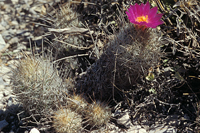 Thelocactus hastifer
Mesa del León, Queretaro
Photo: A. Mosco
enlarge
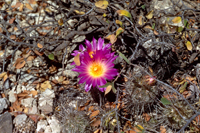 Thelocactus hastifer
Mesa del León, Queretaro
Photo: A. Mosco
enlarge
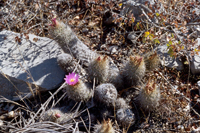 Thelocactus hastifer
Mesa del León, Queretaro
Photo: A. Mosco
enlarge
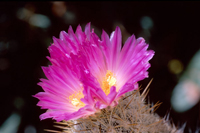 Thelocactus hastifer
Photo: A. Mosco
enlarge