Basionym: Echinocactus conothelos Reg. & Klein, Ind. Sem. Hort. Petrop. 48 (1860).
Neotype: 1 mile southwest of La Perdida, Tamaulipas, Mexico, 22 January 1961, Edward F. Anderson 1725 (POM), E.F. Anderson, Bradleya 5: 66 (1987).
Synonyms: Gymnocactus conothelos Backeb., Die Cactaceae V: 2859 (1961). Torreycactus conothele (Regel & Klein) Doweld, Sukkulenty 1: 19 (1998). Thelocactus conothele var. albiflorus Kladiwa & Fittkau nom. nud., in Krainz, Die Kakteen, C VIII b, 1 IV (1975). Echinocactus smithii Muehlenpf. (nomen utique rejiciendum, Vienna Code Appendix V), Allg. Gartenzeitung 14: 370 (1846). Echinocactus saussieri Weber, Dict. Hort. Bois, 468 (1896). Thelocactus saussieri Berger, Kakteen, 257 (1929). Gymnocactus saussieri Backeb., Cact. Succ. J. (US) 23: 151 (1951).
Description
Stem single, globose, 6-24-(45) cm tall, 7-18 cm wide. Ribs indistinct. Tubercles conical. Areoles with glands. Central spines 4, 13-90 mm long, ochre to greyish, straight, acicular. Radial spines 7-20, 8-12 mm long, ochre to greyish, straight, acicular. Flowers 45-60 mm wide, white to magenta. Seeds 1.8 x 1.6 mm, testa cells conical with a smooth surface.
Distribution
Mexico, Nuevo León, San Luis Potosí and Tamaulipas, occurring in matorral xerofilo on limestone hills, at elevations of about 1200 to 2200 metres above sea level. Its range lies within the Meseta Central subregion of the Chihuahuan Desert ecoregion.
Comments
Thelocactus conothelos and its subspecies (argenteus, aurantiacus, flavus and garciae) are the most different from the other Thelocacti, both for flower morphology (in these species the primary filaments are inserted 4-5 mm above the base of the nectar chamber) and for seed micro-morphology (seed testa cells are conical and the surface of the cuticle is smooth). The seed-coat micro-morphology led Doweld to propose a new genus, Torreycactus, for them, placing it in a distinct phylogenetic line together with Kadenicarpus and Bravocactus, both having seeds with a smooth cuticle. My opinion is that this single trait is not sufficient to segregate conothelos from Thelocactus, especially when all the other characters are congruent with those of the other Thelocactus species.
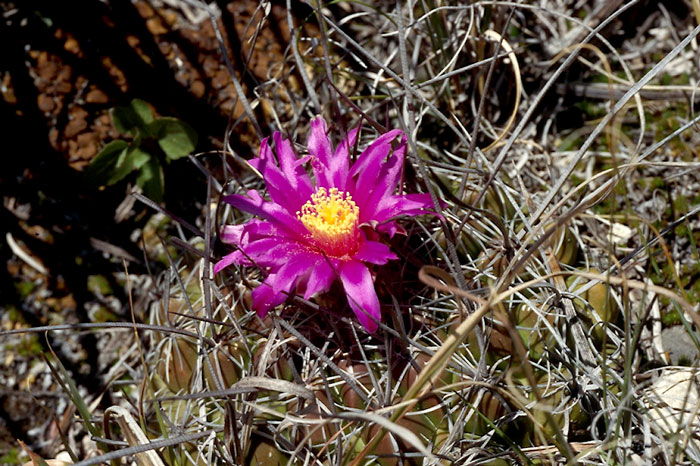
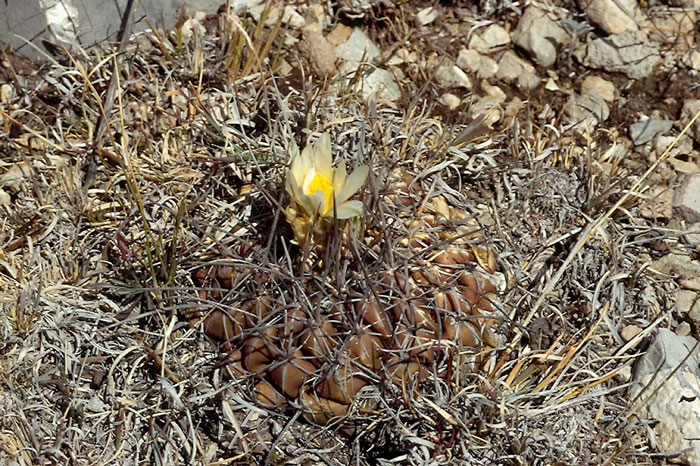
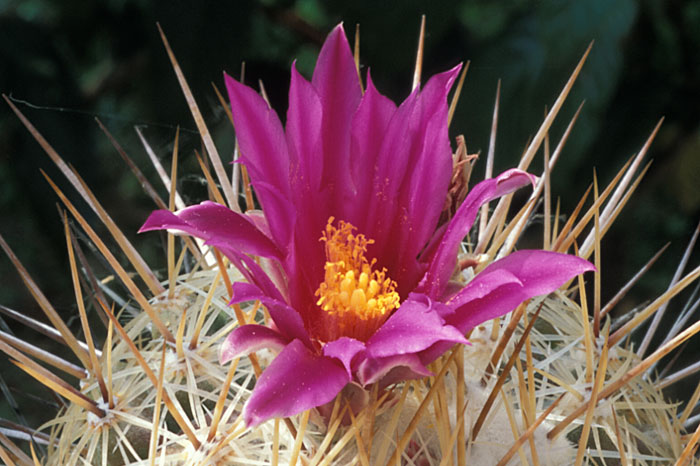
Thelocactus conothelos is the most widespread taxon of this complex, distributed in many localities of the states of Nuevo León, San Luis Potosí and Tamaulipas. The forms with depressed stem growing around Matehuala are known by the name saussieri, while the typical form, with a more elongate stem, is found in Tamaulipas. Flowers are typically magenta, though I know about a population near Matehuala, where white and magenta flowered plants grow together.
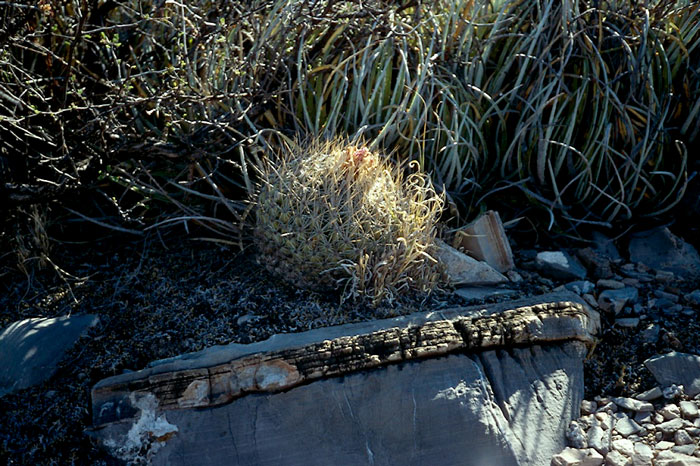
Saussieri is a name referable to the plants with depressed globose stem growing around Matehuala, in Nuevo León and San Luis Potosí. There are no other differences from the type.
Smithii is a name that for many years was used to identify a spiny form of Echinocactus beguinii F. A. C. Weber ex K. Schumann (nom. illeg.) (synonyms: Thelocactus beguinii N. P. Taylor, Turbinicarpus beguinii Mosco & Zanovello, Rapicactus beguinii Lüthy). The name Echinocactus smithii Muehlenpf. has been misapplied since Schumann emended its original description, relying on a specimen sent him by Reichenbach. Specifically, he modified the description of spine arrangement, number, and colour, but not of the flower and fruit, probably because he had not seen them. As Schumann's is a standard reference work, his mistakes were pepetuated. The most important character to assess the relationship of Echinocactus smithii is the ovary. E. smithii was described having the hypanthium covered by large cordate scales with membranous margins. A scaly ovary was described also for Echinocactus saussieri, but not for Echinocactus beguinii F. A. C. Weber ex K. Schumann (nom. illeg.). This difference is sufficient to conclude that E. smithii and E. beguinii are not the same plant. Instead, this and other characters make E. smithii identifiable as Thelocactus conothelos. E. smithii antedates not only Thelocactus beguinii N. P. Taylor, but also E. conothelos. By consequence, T. conothelos should be treated as a synonym of Thelocactus smithii Borg, a name that has never come into use, and its varieties should be recombined under this name. To avoid the need to publish new combinations and to maintain nomenclatural stability, it was proposed to reject the name Echinocactus smithii Muehlenpf. under Art. 56.1 of the International Code of Botanical Nomenclature. The name Echinocactus smithii Muehlenpf. was definitely rejected in the Appendix V of the Vienna Code.
For an in depth discussion see:
Mosco A. & Zanovello C. (1997). Neolloydia gautii Benson: a tangled taxonomic history and two new combinations, Bradleya 15: 77-83.
Mosco A. & Zanovello C. (1999). (1401) Proposal to reject the name Echinocactus smithii (Cactaceae), Taxon 48: 177-178.
Thelocactus conothelos ssp. conothelos (Regel & Klein) Backeb. & F. Knuth, Kaktus-ABC, 385 (1935).
 The neotype of Echinocactus conothelos Reg. & Klein
1 mile southwest of La Perdida, Tamaulipas, Mexico, 22 January 1961, Edward F. Anderson 1725 (POM).
enlarge
Image courtesy Herbarium of Rancho Santa Ana Botanic Garden and Pomona College.
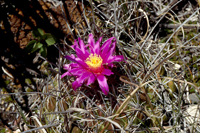 Thelocactus conothelos
Dr Arroyo, Nuevo León
Photo: A. Mosco
enlarge
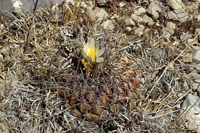 Thelocactus conothelos
Jarillas, Nuevo León
Photo: A. Mosco
enlarge
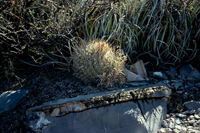 Thelocactus conothelos
Guadalupino, San Luis Potosí
Photo: A. Mosco
enlarge
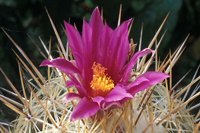 Thelocactus conothelos
Miquihuana, Tamaulipas
Photo: A. Mosco
enlarge