Basionym: Echinocactus buekii Klein ('buckii'), Gartenflora 8: 257 (1859).
Lectotype: Gartenflora 8: 257, Taf. 266 (1859), E.F. Anderson, Bradleya 5: 66 (1987).
Synonyms: Thelocactus tulensis var. buekii (Klein) E.F. Anderson, Bradleya 5: 65 (1987). Thelocactus tulensis ssp. buekii (Klein) N.P. Taylor, CCI 5:14 (1998). Thelocactus buekii ssp. jarmilae Halda & Horacek, Acta Mus. Richnov. Sect. nat. 7: 38 (2000). Thelocactus matudae Sanchez-Mej. & Lau, Cact. Suc. Mex. 23: 51-52 (1978). Thelocactus buekii var. matudae (Sanchez-Mej. & Lau) E.F. Anderson, Bradleya 5: 66 (1987). Thelocactus tulensis ssp. matudae (Sanchez-Mej. & Lau) N.P. Taylor, CCI 5: 14 (1998). Thelocactus buekii ssp. matudae (Sanchez-Mej. & Lau) Mosco & Zanovello, Bradleya 18: 62 (2000). Thelocactus santaclarensis Halda, Kupcak & Sladkovsky, Acta Mus. Richnov. Sect. nat. 7: 39 (2000).
Description
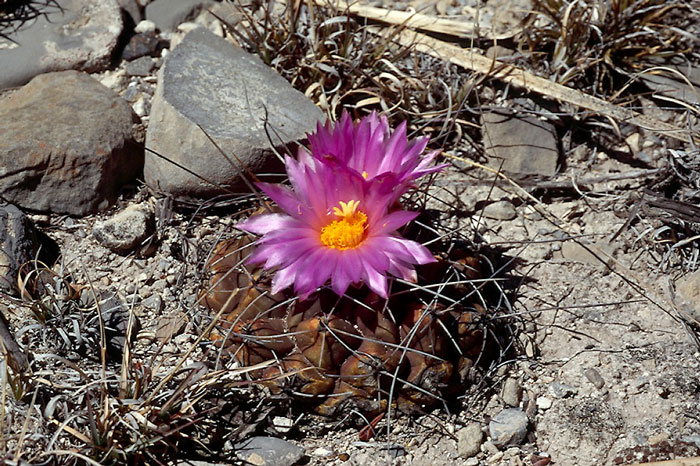
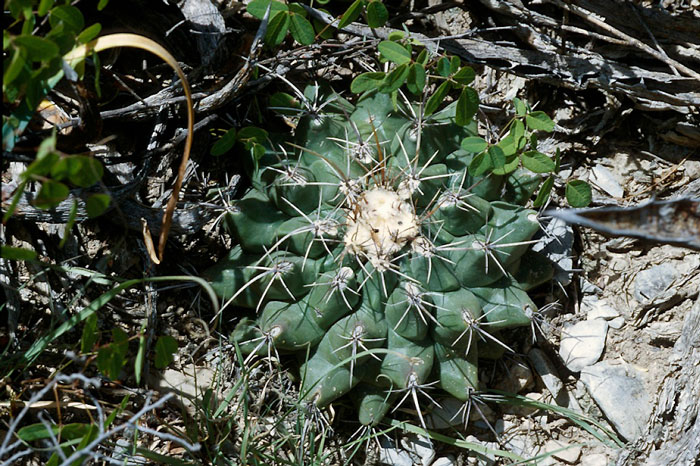
Stem single, depressed to globose, 2.5-14 cm tall, 7-18 cm wide. Ribs indistinct. Tubercles conical. Areoles without glands. Central spines 1-7, 15-80 mm long, ochre to greyish, straight or slightly curved, acicular. Radial spines 4-12, 6-30 mm long, ochre to greyish, straight to slightly curved, acicular. Flowers 35-80 mm wide, magenta. Seeds 2 x 1.5 mm, testa cells convex with a verrucose surface sculpture.
Distribution
Mexico, Nuevo León, in matorral xerofilo on limestone and, rarely, gypsum hills, at elevations of about 900 to 2100 metres above sea level. Its range lies within the Meseta Central subregion of the Chihuahuan Desert ecoregion.
Comments
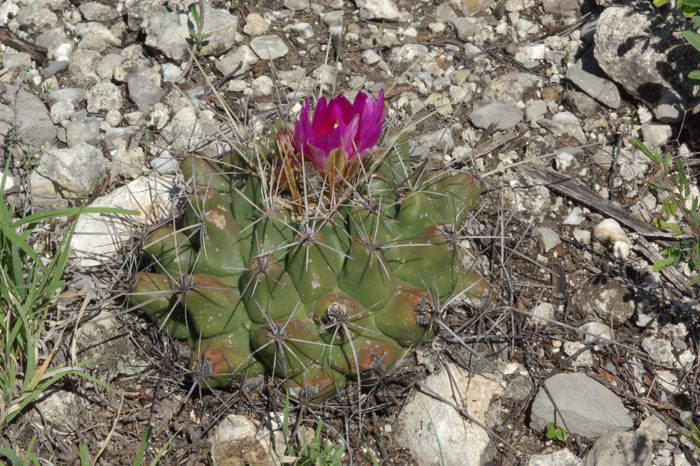
This is a species with a single, depressed stem, generally with reddish hues, completely divided into tubercles. The flowers are strictly magenta. It may be found on the hilly slopes between Dr Arroyo and Galeana, in Nuevo León. Anderson considered buekii and matudae as varieties of Thelocactus tulensis. It is my opinion that buekii and matudae have nothing in common with tulensis, whose seed morphology is completely different. The seeds of buekii and matudae have convex testa cells, while those of tulensis have flat testa cells.
The body is different too, divided in eight ribs in tulensis, while the ribs are indistinct in the other two entities. I think that these differences are sufficient to consider buekii or matudae unrelated to tulensis.
Jarmilae, according to the authors, differs from the type by its smaller size and flowers. An insufficient character to recognise this entity which comes from Asuncion, Nuevo León.
Matudae was described by Lau, who compared it to buekii, stating that it differs from the type for the longer tubercles, the higher spine number and the larger flowers. It occurs near Rayones, Nuevo León, and more to the south this form is gradually replaced by plants with shorter tubercles, less numerous spines and smaller flowers that are typical buekii. Afterwards, several populations were discovered showing characters in between those of the two subspecies, confirming the gradual variation of characters between the northern forms (matudae) and the southern ones (buekii). Due to the high variability of these characters in the different populations, I think it is better not to raise matudae to subspecies or variety rank.
Santaclarensis is reported as coming from Santa Clara, Nuevo León, the description telling us that it is similar to buekii, matudae and rinconensis, with rose flowers. I feel that it is nothing more than another form of buekii.
Thelocactus buekii (Klein) Britton & Rose, Cact. 4: 8 (1923).
 The lectotype of Echinocactus buekii Klein.
From: Gartenflora 8: 257, Taf. 266 (1859).
The lectotype of Echinocactus buekii Klein.
From: Gartenflora 8: 257, Taf. 266 (1859).
enlarge
Image courtesy Biodiversity Heritage Library and Smithsonian Institution Libraries.
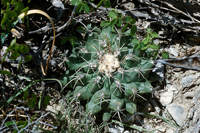
 Thelocactus buekii
La Escondida, Nuevo León
Photo: A. Mosco
enlarge
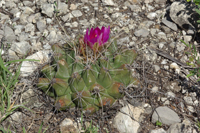
 Thelocactus buekii
Las Delicias, Nuevo León
Photo: A. Mosco
enlarge
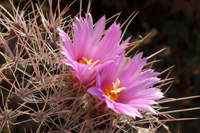
 Thelocactus buekii "matudae"
Pedro Caricales, Nuevo León
Photo: J. Jauernig
enlarge
 Thelocactus buekii "matudae"
Photo: A. Mosco
enlarge